the struggle for a standard
Currencies today are much different from currencies in the past. While today’s currencies have become completely fiat, those of the past had to depend on a backing system to be able to retain public trust. Specifically, a gold and silver standard (or a bimetallic standard) was used as the basis for most monetary systems. Yet, over time, the existence of both metals oversaturated the monetary system, leading to a furious battle over what should remain, and what must go.
Technically, the U.S. did not officially convert to a gold standard until the Gold Standard Act of 1900. In reality, it had practically been on a gold standard since 1834 due to the Coinage Act of that year, making gold more valuable relative to silver. The Coinage Act of 1873, dubbed the “Crime of ‘73,” further cemented this trend by prohibiting further minting of silver into specie. The Act itself was a general revision regarding coinage and minting in general, by establishing new roles, weights, and regulations regarding the minting of coins. What gave the Act the name “the Crime of ‘73” was how it deliberately targeted silver in the money supply. While the Act did not outright say that “no further coining of silver,” it made it so that silver could not be minted into a “standard dollar.”
Prior to 1873, silver bullion could be freely sent and coined into a normal dollar, no matter the value of silver at the time. As a result, whenever the market value of silver fell, common workers would turn in their silver to get the coins at full value. However, Section 17 in tandem with Section 15 of the Act made it so that silver could only be minted into trade dollars (used only to trade with the East), or small coins of half-dollars, quarters, or dimes (which were only legal tender for limited amounts). The silver dollars that were already in circulation were allowed to continue circulating, but no further coins were to be minted. Supplies were already dwindling due to the Coinage Act of 1834, but by further restricting them, America was essentially announcing its transition towards a definitive gold standard. The outcry over the Act was compounded by the chaos from the “Panic of 1873,” which stemmed from railroad overexpansion, collapsing stock markets in Europe, and major bank failures.
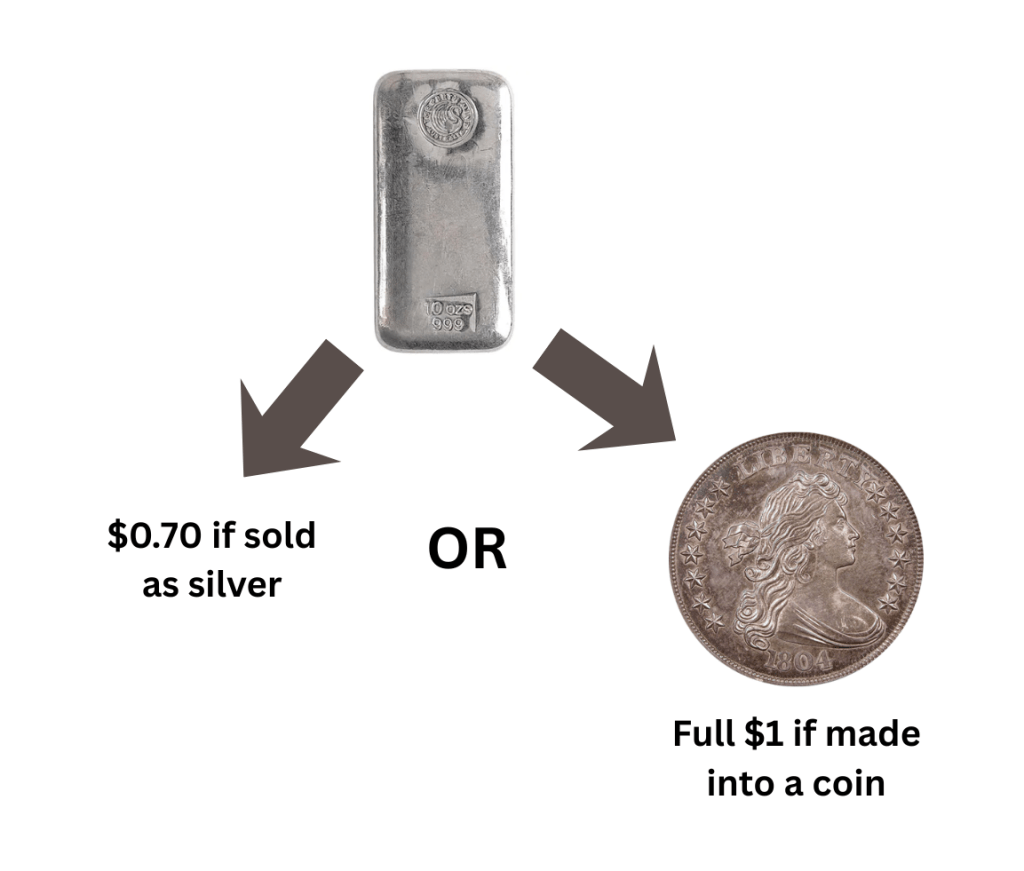
In an effort to placate the outraged silver supporters, Congress signed the Bland-Allison Act in 1878, titled “An act to authorize the coinage of the standard silver dollar, and to restore its legal-tender character.” However, the Act did not do so fully, but rather mandated the Treasury to buy and mint $2-4 million worth of silver bullion into standard silver dollars every month. This was further expanded with the Sherman Silver Purchase Act in 1890, which forced further purchases upon the Treasury with an additional 4.5 million ounces of silver every month. Ironically, payments could only be made with gold notes, leading to a further division between gold and silver. Burdens were further compounded on the gold reserve due to the new mandates on silver purchases, a reserve that was already being stressed due to the effective removal of silver. In a similar vein to the Panic of 1873 two decades prior, the Panic of 1893 arose from railroad overexpansion, bank failures, and market instability, exacerbated this time by a severely overstretched gold reserve.
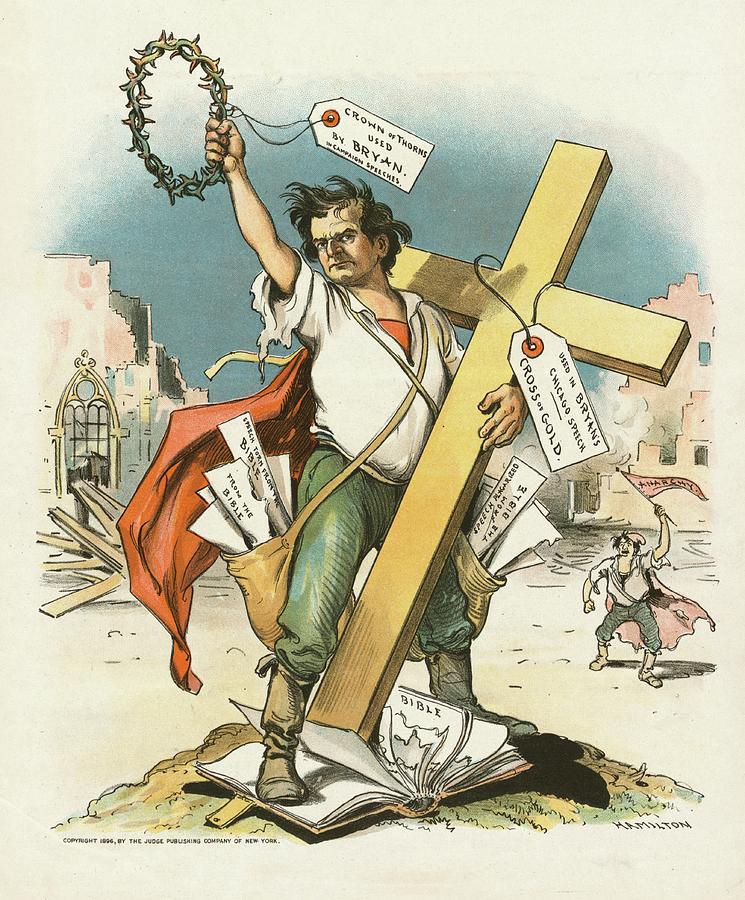
Arguments and debates raged on as people fought over the continuation of bimetallism, with one of the most notable moments being William J. Bryan’s “Cross of Gold” speech. In stark contrast to the economic concerns commonly raised by advocates of the removal of silver, Bryan’s speech emphasized the suffering of the ordinary American. The speech electrified the 1896 Democratic Convention, culminating in an emotional climax where he declared: “YOU SHALL NOT PRESS DOWN UPON THE BROW OF LABOR THIS CROWN OF THORNS. YOU SHALL NOT CRUCIFY MANKIND UPON A CROSS OF GOLD.” His speech roused the hearts of many across the country and garnered enough supporters for him to be named the Democrats’ presidential candidate. However, despite the influence of the speech, Bryan lost the 1896 election to the Republicans’ William McKinley, and on March 14, 1900, a year before the start of the 20th century, President McKinley would sign the aptly named Gold Standard Act, marking the United States’ official adoption of the gold standard. The Act did not remove silver dollars from circulation, but rather made it so that gold was the only metal against which the U.S. dollar’s value would be pegged against.
References:
Coinage Act of 1873, ch. 131, 17 Stat. 424 (1873)
Bland-Allison Act, ch. 20, 20 Stat. 25 (1878)
Sherman Silver Purchase Act, ch. 708, 26 Stat. 289 (1890)
Benjamin Rush Davenport and William Jennings Bryan, The “Cross of Gold.” (Buffalo, NY: Kratz Publishing Co., 1896), 13, https://www.loc.gov/item/09032200/.
 Currency Cornucopia