The postwar dollar shortage evolved into a dollar glut as U.S. foreign investment and military spending increased. The Triffin dilemma exposed the conflict between supplying global liquidity and maintaining gold convertibility. Despite Operation Twist and the London Gold Pool’s efforts to stabilize confidence, declining gold reserves, foreign redemptions, and international tensions made the system increasingly unsustainable.
The fact that the U.S. dollar was instrumental to any and all trade with the U.S. coupled with the fact that the U.S. was the biggest economy meant that, for recovering countries, there was a massive dollar shortage. The Americans proceeded to remediate the issue by increasing their foreign investments by an extraordinary degree, building factories and infrastructure, alongside heavy military spending due to the Cold War. These outflows created a “dollar glut,” a situation where there were simply too many dollars in the system for the U.S. to completely back with gold. With European countries restoring free exchange in 1958, allowing for free exchange between their currencies and the U.S. dollar, the dollar stood at the top of the global exchange market by an even further margin than before.
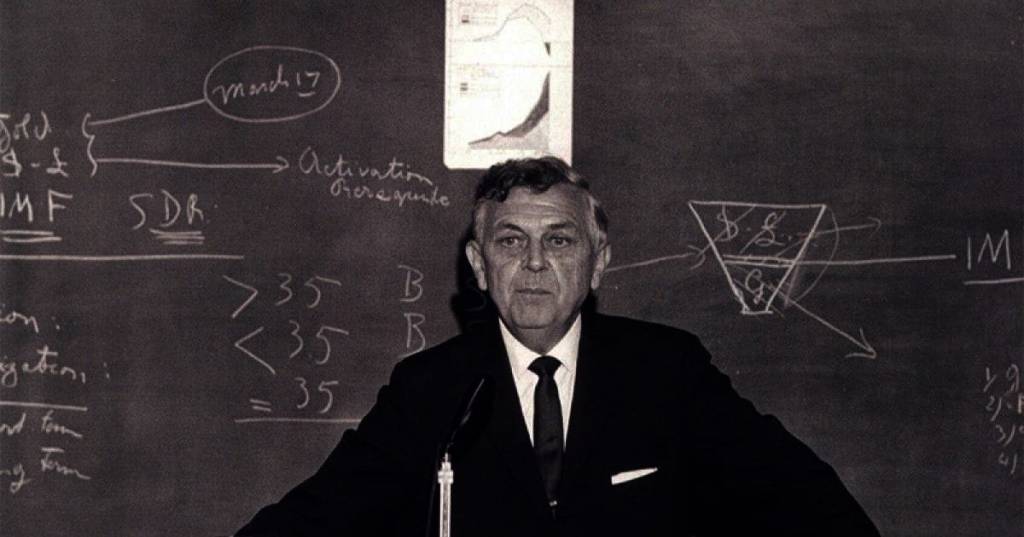
During this time period, the “Triffin dilemma” was identified by economist Robert Triffin, in that there will be a conflict of interest between a country’s short-term national economic interests and its responsibility to maintain global liquidity. As the main reserve currency, the U.S. dollar must be accessible to all foreign governments, and thus America had an obligation to supply large quantities of dollars to the global market by maintaining a deficit in its balance of payments. However, this came with the risk of the U.S. running out of gold if these holders decided to redeem their dollar holdings, as well as a weakening of confidence both domestically and internationally as the dollar stockpiled in foreign reserves. In a letter from a Special Assistant in the Office of the Secretary of State to a UN ambassador, it was said that out of the U.S.’s total reserves of $22 billion by 1957, a reserve that had slowly been decaying in the aftermath of the war, only $10 billion was available to back foreign dollar holdings. Comparatively, dollar holdings had doubled from $8 billion to an astounding $16 and a half billion, creating a gap of $6 and a half billion that the U.S. simply could not back.
In 1961, the Kennedy administration introduced “Operation Twist” to defend the dollar’s plummeting confidence as well as stimulate economic growth. The operation was separated into two parts: the Federal Reserve would sell nearly all of its short-term Treasuries, while simultaneously buying new long-term bonds. The purpose of the first action was to discourage investors from converting their dollars to gold, as by selling the short-term bonds, the prices of the bonds themselves would decrease, yet the yield would remain the same, allowing for short-term interest rates to rise. This would make the dollar attractive to investors, as by using those dollars and investing in Treasury bonds, they would get a higher guaranteed return rate than before. The purchasing of long-term bonds would decrease interest for long-term borrowings, which in turn would make it easier for both individuals and firms to take loans or mortgages.
It should be noted that even though encouraging investors to hold dollars and buy Treasury bonds may seem similar to restoring confidence for the currency, the two have distinct differences. Confidence and trust in the dollar were weakening because the U.S. could not sufficiently back all the bills that were in circulation around the world. As a result, central banks and foreign investors resorted to converting their dollar holdings to gold out of fear that it might lose value if the U.S. dollar maintained its downward trajectory. Operation Twist was targeted at solving the issue of investors redeeming their dollar for gold, not at solving the issue of the dollar losing confidence and credibility.
Source: FRED.
Within 1961, the eight central banks from the following countries formed what is known as the “London Gold Pool”: the U.S. (Federal Reserve), the U.K. (Bank of England), France (Banque de France), Germany (Deutsche Bundesbank), Italy (Banca d’Italia), Belgium (Banque Nationale de Belgique), the Netherlands (De Nederlandsche Bank), and Switzerland (Schweizerische Nationalbank). The Pool was formed to stabilize and maintain the dollar-to-gold peg from the Bretton Woods system and restore confidence in the dollar. Moreover, it also aimed at stabilizing market prices for gold at around $35/oz by buying and selling gold within the member states. As usual, the U.S. maintained the largest share of contribution in the Pool with roughly 50% of the total Pool, while the rest was contributed by the other seven nations.
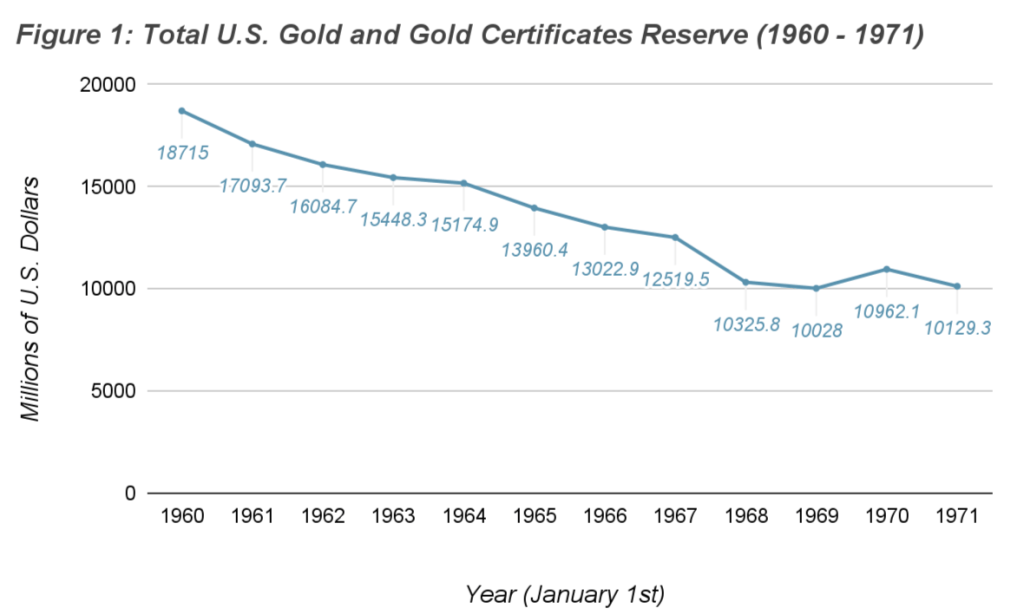
However, as U.S. reserves had been shrinking ever since the aftermath of World War II, and continued to lessen rapidly as spending increased for the Vietnam War, it was obvious that America could not sustain the continued annual contribution to the Gold Pool. Figure 1 shows that between 1961 and 1968, U.S. gold and gold certificates reserves fell by around $6 767.9 million, not only due to the Vietnam War but also due to other central banks redeeming their dollar holdings for gold. Foreign dollar holdings were effectively backed by nothing, as the U.S. was struggling even to support domestic dollars. Between the U.S.’s strained reserves, the push-back received from France, who referred to the U.S. dollar giving the country an “exorbitant privilege,” and the pound devaluing itself once again, from $2.80 per pound to $2.40, made the collapse of the London Gold Pool inevitable.
References:
Greene, J. N. (1957, October 24). Memorandum from the Special Assistant in the Office of the Secretary of State (Greene) to the Ambassador to the United Nations (Lodge) (Doc. 128). In J. P. Glennon (Ed.), Foreign Relations of the United States, 1955–1957: Foreign Economic Policy; Foreign Information Program (Vol. IX). U.S. Government Printing Office. https://history.state.gov/historicaldocuments/frus1955-57v09/d128
Tim Sablik, “Operation Twist,” Region Focus, Fourth Quarter 2012, https://www.richmondfed.org/publications/research/econ_focus/2012/q4/jargon_alert
Center for Financial Stability, Resources and Assets: Gold and Gold Certificates: Total Gold; Gold Certificate Reserve, FRED, accessed November 20, 2025, https://fred.stlouisfed.org/series/RAGGCTGGC
Michael Bordo, Eric Monnet, and Alain Naef, The Gold Pool (1961–1968) and the Fall of the Bretton Woods System: Lessons for Central Bank Cooperation, NBER Working Paper 24016 (Cambridge, MA: National Bureau of Economic Research, 2017), https://doi.org/10.3386/w24016

