The Nixon Shock of 1971 ended dollar convertibility into gold, addressing unsustainable reserve pressures and domestic economic challenges. Despite temporary stabilization through the Smithsonian Agreement, persistent speculation, rising gold prices, and international tensions undermined efforts to restore fixed exchange rates. By 1973, major currencies floated freely, marking Bretton Woods’ definitive collapse.
If one were to summarise the role of gold throughout the entirety of its existence as a form of currency, it would be to maintain confidence and stabilize the economy. For over a millennium, people have grown to trust and value gold, perhaps more than what it is truly worth, and even to this day, the metal remains as valuable as ever. Yet, due to this unwavering faith, any other currency that was not gold had to depend on it to be trusted, ultimately restricting the economic flexibility and growth that could have otherwise been possible. And despite the vast stores of gold accumulated over the years, it remains a finite resource, unable to keep pace with the rising demand for money in an increasingly complex and expanding global economy. The creation of Special Drawing Rights (SDRs) by the IMF in 1969 did help support reserves somewhat, but it could not fully make up for the weakening of the dollar as a reserve asset. It is for precisely this reason that the “Nixon Shock” in 1971 was not truly a “shock” at all, but more an inevitability that the world would have undergone one way or the other.
By 1971, the U.S. dollar was weak, more so than it had been in years. Inflation was rampant, reducing the purchasing power of the dollar. Spending on the Vietnam War and other societal reforms continued to rise, and foreign investments by the U.S. were as plentiful as ever, increasing the supply of dollars to an astronomical degree. All the while, gold reserves continued to drain as central banks and private investors traded their dollars for gold. The peg at $35/oz of gold, which had been in place for nearly four decades, caused the nation to strain as it tried to defend the par, and it was expected that the U.S. would once again devalue the dollar to a more reasonable rate. Confidence in the dollar further plummeted as investors opted for other currencies, such as the yen, in anticipation of a realignment. Change was necessary, lest the U.S. economy crumble underneath the weight of its responsibility to uphold the parity. Yet few anticipated how abrupt or radical that change would be.
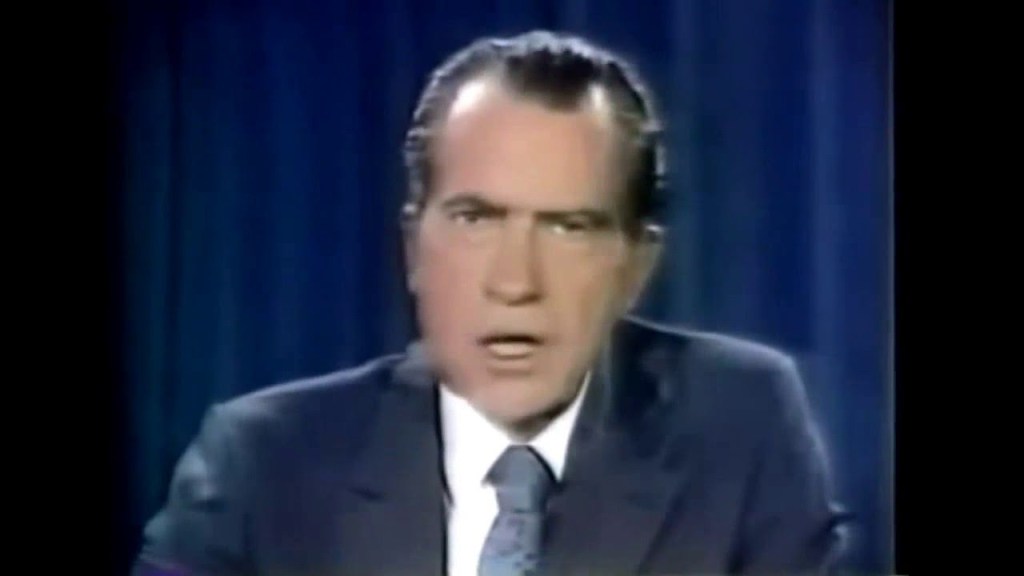
Possibly the single most important event in global financial history, the “Nixon Shock” completely redefined the fundamental way that money and markets operated. The announcement itself, made in the midst of the Vietnam War, came as a surprise for most. Only 2 days before the official statement, President Richard Nixon held a meeting with a few of his most trusted economic advisors, although the meeting notably lacked then Secretary of State William Rogers as well as President’s Assistant for National Security Affairs Henry Kissinger. Then, on August 15, 1971, Nixon went on television to address the entire nation, in which he mentioned that there were three sectors to focus on in a post-Vietnam world: employment, inflation, and money speculation. The changes to each sector are summarised within the following list:
- In regard to unemployment: increase 10% Job Development Credit, removal of the 7% auto excise tax, accelerated personal income tax exemptions, a cut of $4.7 billion in federal spending, postponed federal pay raises and a 5% personnel cut, a 10% reduction in foreign aid, and delays to revenue sharing and welfare reform.
- In regard to inflation: a 90-day freeze on all prices and wages, a call for corporations to extend the freeze to dividends, and the creation of a Cost of Living Council to coordinate post-freeze stability, all temporary and relying on voluntary cooperation.
- In regard to money speculation (dollar confidence): temporary suspension from gold or other reserve assets convertibility (possible exceptions in the interest of the U.S.), a temporary 10% increase to import taxes (not targeted towards any country).
In spite of the President framing it as “temporary,” the window for convertibility never reopened. Gold was gone for good, and by 1973, all currencies were floating freely. New import taxes were implemented to reduce the deficit in the U.S. balance of payments, thereby reducing the supply of dollars to the international community. Furthermore, an inadvertent effect of targeting inflation by freezing wages and prices and increasing the purchasing power of each dollar was restoring public confidence in the currency.
In theory, the policies directly targeted the issues at hand, encompassing enough areas to be effective, and to a certain extent domestically, they were, for inflation rates fell from 4.3% to 3.3% between 1971 and 1972. In tandem with the Smithsonian Agreement, the U.S. experienced a 6% economic growth in real terms, and the aggregate deficit dropped sharply from $29.8 billion in 1971 to a more manageable $10.4 billion in 1972. Foreign backlash was even expected, with the President stating:
“Now, this action will not win us any friends among the international money traders. But our primary concern is with the American workers, and with fair competition around the world.
To our friends abroad, including the many responsible members of the international banking community who are dedicated to stability and the flow of trade, I give this assurance: The United States has always been, and will continue to be, a forward-looking and trustworthy trading partner. In full cooperation with the International Monetary Fund and those who trade with us, we will press for the necessary reforms to set up an urgently needed new international monetary system. Stability and equal treatment is in everybody’s best interest.”
Yet, perhaps the President did not expect the magnitude of the controversy the decision would receive. Most investors saw the radical policy changes as a sign of instability, and speculation on the dollar increased as they scrambled to exchange it for more stable currencies. Moreover, it was not easy for other countries to adjust to the sudden removal of the gold standard, which further worsened international views on the United States. It did not help that the U.S. decided to cut 10% of foreign aid, nor the fact that there was now a new 10% import tax. Of course, these decisions were reasonable within their context, that foreign economies were now strong and proud competitors and America no longer had to “compete with one hand tied behind her back,” but they still nonetheless negatively affected international perception for the country. The shift was needed, and although the method used by the U.S. may have been jarring, even slightly rough, it ultimately shaped the monetary system still used to this day.
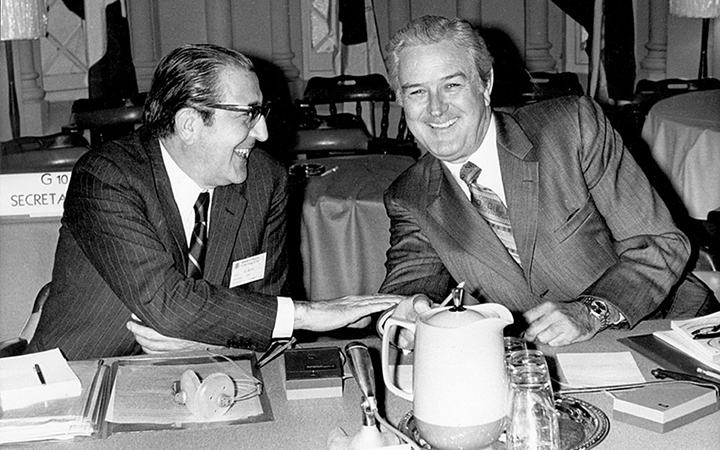
The uncertainty in FX rates demanded action, and thus the Smithsonian Agreement was born between the G-10 countries (U.S., U.K., France, Belgium, Germany, the Netherlands, Switzerland, Japan, Italy, Canada). The Agreement set fixed rates in relation to the dollar by allowing a maximum of a ±2.25% deviation, reverted the 10% import duties, as well as the related provisions in the Job Development Credit section, and devalued the gold-dollar par to $38/oz (after approval from Congress). Moreover, countries agreed to continue talks regarding wider monetary reforms. The devaluation showed the U.S.’s admission that the dollar was indeed overvalued, and also aimed to reduce the deficit by letting other currencies appreciate against it.
The dollar-gold parity change was more symbolic than anything, for the gold convertibility window never reopened. Gold prices rose quickly, reaching $47/oz within a few weeks of the Agreement, and by June 1972, prices were at $65/oz. The deficit also worsened as there was a lack of capital inflows, due to comparatively low interest rates in both short and long-term bonds to other countries, and speculation regarding further changes to the dollar-gold par discouraged investments into the country.
Furthermore, it is said that “the antipathy that developed after the suspension of dollar convertibility in August 1971 between U.S. officials and officials of the then six countries of the European Community (EC) […] continued and even worsened.” Consequently, the EC decided to strengthen its ties by establishing its own monetary controls by halving the margins to ±1.125% for currencies within the community. The exchange market did stabilize towards the end of 1972, yet the U.S.’s refusal to re-adopt the gold convertibility, combined with mounting speculative pressures, was slowly removing any hope of re-establishing the Bretton Woods system.
It began with the U.K., as the pound began to float independently on June 23, 1972. By February 12, 1973, the Italian lira joined the pound, soon followed by the Japanese yen and the Canadian dollar. March 12, 1973, marked the day when 6 EC nations (Belgium, Denmark, France, Germany, Luxembourg, the Netherlands) established a joint float, where their own currencies would still operate within the previous margin, but there were no limits vis-à-vis the U.S. dollar. The joint float solidified the failure of the Smithsonian Agreement as the dollar was now completely alone within its boundaries. There was no fanfare, no official announcement, nothing at all to announce the complete untethering of gold. Rather, markets simply adjusted to the reality that the dollar would now float independently against major currencies, signaling the definitive collapse of the Bretton Woods framework.
References:
Richard M. Nixon, “Address to the Nation Outlining a New Economic Policy : The Challenge Of Peace,” Papers of Richard M. Nixon, August 15, 1971, https://fraser.stlouisfed.org/archival/1173/item/3390
IMF, Inflation, consumer prices (annual %) – United States, World Development Indicators, accessed November 24, 2025, https://data.worldbank.org/indicator/FP.CPI.TOTL.ZG?locations=US
International Monetary Fund, IMF History, 1972–1978, vol. 1 (Washington, DC: International Monetary Fund, 1996), 25, https://doi.org/10.5089/9781451922684.073
World Gold Council, “Smithsonian Agreement of the Group of Ten,” After the Gold Standard, 1931-1999, Volume III, December 1971, accessed November 24, 2025, https://www.gold.org/sites/default/files/documents/after-the-gold-standard/1971dec.pdf

