the birth of a national currency
From the moment America gained independence, it immediate established a new currency as a way to solidfy that independence. Yet, the original dollar that was created by the U.S. constitution differs substantially from the dollar today.
When the American Revolutionary War broke out, the Continental Congress decided to fund its military operations by issuing the Continental Currency. Unlike coins, the Continental was not backed by gold or silver, which caused confidence in the currency to plummet. Moreover, in their efforts to finance the ever-increasing needs of the war, the colonies and Congress printed a staggering amount of paper money over the course of five years. These factors, alongside Great Britain’s attempts at counterfeiting, caused hyperinflation to run rampant during this period, giving rise to the phrase “not worth a Continental.”
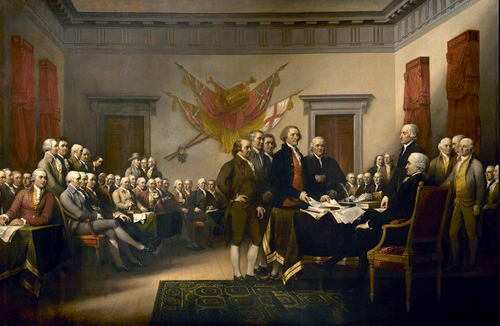
Following independence, the newly formed United States of America immediately took action to solve the ongoing financial crisis. To begin, the Constitution granted Congress the authority to coin money and regulate its value, while also prohibiting states from minting their own money. This was then further reinforced with the Coinage Act of 1792, which established the U.S. dollar as the official currency of the nation. The Act allowed for the minting of coins in gold (eagles), silver (dollars), and copper (cents), as well as introduced a decimal system that added denominations to simplify trading and payments. Section 9 of the Act mentions that a single dollar was equivalent to 24.75 grains of pure gold (since $10 was equal to 247.5 grains) or 371.25 grains of pure silver, making the ratio of gold-to-silver 15:1.
This bimetallic standard ensured that both metals could circulate the market as legal tender (money that is recognized and accepted by the state as a means for settling payments/debts) while keeping the dollar’s value fixed, thus strengthening public confidence in the currency. During this time, the term dollar represented a unit of value defined by the weight of the metal. By comparison, the modern U.S. dollar is a fiat currency that circulates independently and holds value on its own without being linked to any physical asset. Its value is completely dependent on the view and interpretation of the people, shown by its constant fluctuations. Meanwhile, these coins held a fixed value based on the weight and purity of the metal used to mint them.
an experiment in centralized banking
Today, the Federal Reserve operates as the sole central bank of America. However, it was not the first national bank established by the nation, for in the beginning, America went through several trial-and-error periods regarding its banking system.
A year before the Coinage Act, Alexander Hamilton, then Secretary of the Treasury, proposed and formed the first national bank. Alongside governmental duties like collecting taxes or paying the government’s bills, the Bank of the United States issued paper money that could be redeemed for gold/silver and was accepted as payment for federal taxes, unlike state bank notes. Despite facing severe political opposition, chiefly from the then Secretary of State Thomas Jefferson, the bank contributed significantly to the stabilization of the economy until its closure in 1811 after its charter expired and the Senate refused to renew it.
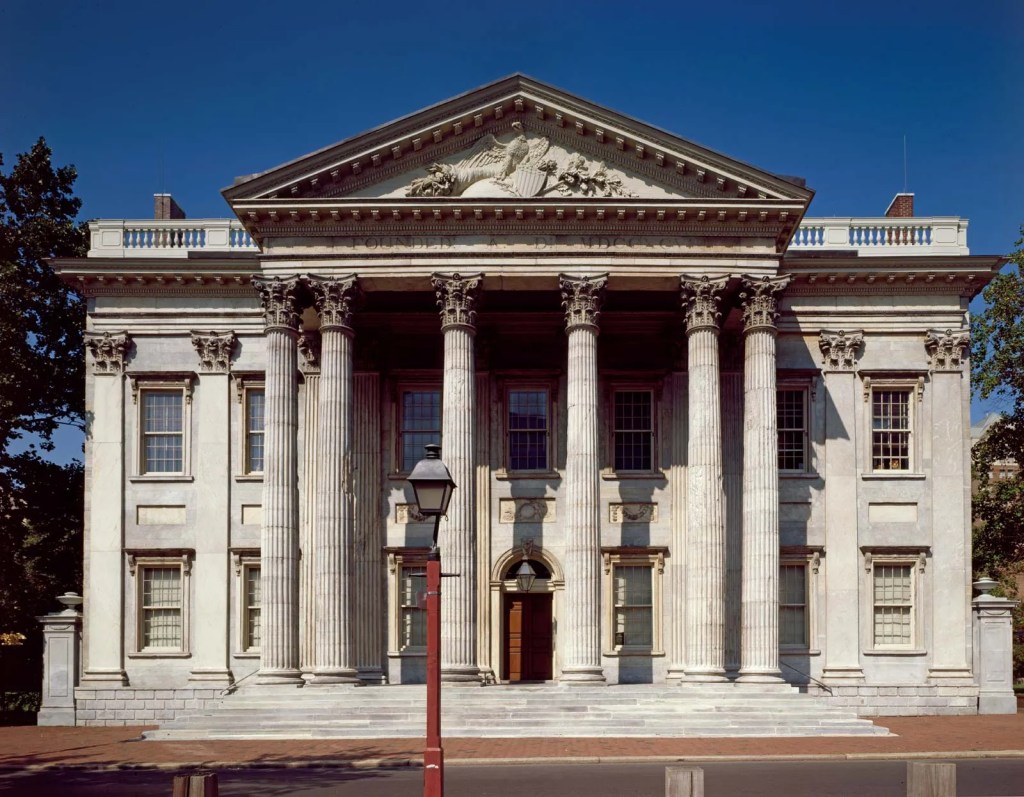
During the War of 1812, national debts rose at a prodigious rate as the government struggled to finance the war, while paper money rapidly lost value as state banks issued increasing amounts of unchecked loans without proper backing. In response, a new central bank, aptly named the Second Bank of the United States, was established in 1816, which helped restore the value of paper notes in trading. However, the bank soon became a focal point of major political contention, culminating in the “Bank War” between President Andrew Jackson and Nicholas Biddle, president of the Second Bank of the United States. Influenced by both personal experience and political views, President Jackson held a strong distrust of paper money and the banking system in general. After vetoing a charter renewal request by Congress, Jackson ordered the removal of all federal deposits in the Second Bank and their redistribution to state banks. His firm stance against the Second Bank of the United States eventually forced its closure in 1834.
In the same year, Congress passed the Coinage Act of 1834, which altered the official gold-to-silver ratio from 15:1 to around 16:1. By overvaluing gold relative to silver, the Act encouraged gold coins to re-enter circulation, while silver coins were hoarded or exported abroad. By devaluing silver, many banks were forced to make the shift towards gold, which proved difficult for smaller institutions that lacked sufficient reserves. This had a major effect on the value of banknotes, since notes held varying strength dependent on the credit of the bank that printed them, but it is unknown whether or not this was done intentionally by President Jackson. Nevertheless, the Act managed to somewhat lighten the burden of lacking a centralized banking institution on the U.S. economy by reintroducing gold coins into the money supply. However, by weakening the bimetallic system and paper money, it would later contribute to the event known as the “Panic of 1837.”
In addition to forcing the closure of the Second Bank and signing the Coinage Act, President Jackson signed the Specie Circular, an executive order aimed at curbing land speculation (buying land with the hope of reselling it for a profit) and the excessive issuance of paper money in 1836. The order required that all public land be purchased with coins rather than banknotes, prompting a scramble to redeem paper notes for gold or silver. As banks’ coin reserves dwindled and confidence in paper money collapsed, borrowing became more difficult, and the overall money supply in the economy shrank. With no national bank to regulate the supply of banknotes while economic troubles in Britain reduced investments and demand for American exports, these factors triggered the “Panic of 1837.” The disaster led to widespread bank failures, soaring unemployment, and a prolonged economic depression that lasted well into the mid 1840s.
The Free Banking Era began in 1837 and lasted until 1863. During this period, state-chartered banks were free to issue their own currency, leading to a continued oversupply of banknotes and widespread instability. These banknotes were not legal tender, so no individual or organization was obligated to accept them. Only gold and silver were considered legal tender at this time. There was minimal oversight and regulation from the government regarding the banking sector, allowing for a rapid proliferation in new banks, a phenomenon referred to as “wildcat banking.” The chaotic landscape showcased a need for a centralized structure overseen by the federal government, one that would be built amidst the fires of the Civil War.
References:
Coinage Act of 1834, ch. 95, 4 Stat. 699 (1834)
Bank of the United States Act, ch. 10, 1 Stat. 191 (1791)
Andrew T. Hill, “The First Bank of the United States, 1791–1811,” Federal Reserve History, December 4, 2015, https://www.federalreservehistory.org/essays/first-bank-of-the-us, accessed September 29, 2025.
Andrew T. Hill, “The Second Bank of the United States, 1816–1841,” Federal Reserve History, December 5, 2015, https://www.federalreservehistory.org/essays/second-bank-of-the-us, accessed October 1, 2025
Coinage Act of 1834, ch. 95, 4 Stat. 699 (1834)
Peter L. Rousseau, “Jacksonian Monetary Policy, Specie Flows, and the Panic of 1837,” The Journal of Economic History 62, no. 2 (2002): 457–88, http://www.jstor.org/stable/2698187
 Currency Cornucopia